By Robbie Gould | 02/03/2026
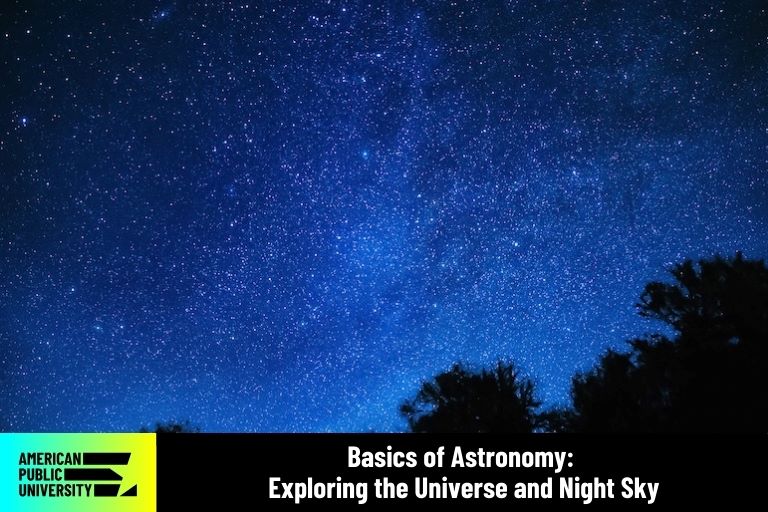
The basics of astronomy introduce one of humanity’s oldest scientific disciplines. Long before telescopes or satellites existed, people were looking up at the night sky and wondering about the constellations above them.
Today, astronomy remains a core branch of modern science. This discipline brings together observation, theory, and technology to study objects far beyond Earth.
By learning the fundamentals of astronomy, students can discover how scientists observe the universe, collect evidence, and turn those observations into knowledge.
This field of science focuses on objects in the sky, including:
- Stars
- Planets
- Moons
- Galaxies
- Other celestial bodies
Together, these objects make up a vast cosmos governed by physical laws that can be tested and measured. While astronomy often inspires curiosity and wonder, it is also a rigorous scientific study grounded in data, mathematics, and physics. Understanding this science helps explain how astronomers move from simply observing objects in the sky to understanding how the universe works.
A Brief History of Astronomy
Astronomy began with early civilizations who observed the night sky using only the naked eye. Ancient societies tracked the motion of the sun, moon, and stars to create calendars and predict seasonal changes. These observations were essential for agriculture, navigation, and daily life.
The first mention of constellations occurred as far back as 270 B.C. Centuries ago, stargazers used methods such as averted vision to detect fainter objects in the sky.
During the Middle Ages, astronomy continued to develop through the work of scholars around the world. Islamic astronomers preserved earlier Greek texts. Later, scholars built upon those texts to advance instruments like the astrolabe and quadrant to improve predictions of planetary motion and eclipses.
These advances laid the groundwork for modern astronomy, demonstrating that observation and mathematical modeling could reliably explain and anticipate celestial events.
In the early 1990s, scientists discovered the existence of exoplanets (other planets beyond our solar system). To date, more than 6,000 exoplanets have been found.
In modern times, satellites, radio telescopes, and space-based observatories changed how scientists studied space. Advances in computing and technology made it possible to collect and analyze large amounts of data with greater accuracy.
Together, these developments shaped astronomy into the professional scientific discipline it is today.
Studying Our Skies
Astronomy focuses on celestial bodies and other related phenomena. Some may confuse it with space studies, which is a broader branch of space science combining astrophysics and planetary science.
A core discipline within space science, astronomy examines a wide range of topics, ranging from nearby stars to distant galaxies. Our home, the Milky Way galaxy, contains billions of stars, planets, and clouds of gas and dust.
Distances in space are measured in light years, which are around 5.8 trillion miles. Beyond the Milky Way are countless other galaxies spread across the observable universe. Each one offers clues about how the cosmos formed and evolved.
Scientists today study nearby stars far beyond the reach of human travel and the naked eye. Astronomers also study other objects that cannot be seen directly, such as black holes and (theoretically) dark matter. These objects reveal their presence through gravity rather than the light we can see.
By studying these structures together, scientists can explain how the universe developed over time. Astronomers also analyze gravitational forces to better understand how planets formed and as well as the life cycle and stability of stars.
Observational Astronomy vs. Theoretical Astronomy
Professional astronomers combine two broad approaches to their work. Observational astronomy deals with what can be seen, measured, and recorded. Theoretical astronomy tries to make sense of those measurements.
Scientific observation can describe what is happening, but not why. Theory can propose explanations, but only data can confirm them. Learning to navigate between the two is a central part of this field.
Most working astronomers move back and forth between the two without thinking much about the distinction.
Observational work begins with the sky itself. Astronomers use telescopes and sensors to capture light, track motion, and measure changes over time. That work might mean:
- Monitoring a planet’s orbit
- Measuring how a star’s brightness fluctuates
- Mapping a distant region of space
Theoretical astronomy steps in once patterns start to appear from observational data. Using physics and mathematics, scientists build explanations for what the data seems to show. These models are tested, revised, and sometimes abandoned when new observations come along.
When predictions hold up, their confidence grows, but uncertainty is always part of the process. This back-and-forth is how professional astronomy moves forward.
Light and the Electromagnetic Spectrum
Almost everything astronomers know about space comes from light in one form or another. Not all of that light is visible, and most of it never directly reaches human eyes.
Visible light represents a small portion of the electromagnetic spectrum. Beyond visible light are many other forms of electromagnetic radiation – other unseen wavelengths of light – that carry information.
The atmosphere of Earth filters much of this radiation before it reaches the ground. Some wavelengths never make it through at all.
Space-based instruments exist largely to get around this limitation. Understanding how light behaves across the spectrum allows astronomers to interpret instrumentation data.
Different wavelengths highlight different features. For example, radio waves can pass through dust and reveal large structures in galaxies. Similarly, X-rays and gamma rays point to violent, high-energy events, such as black holes or stellar explosions (also known as supernovas).
No single wavelength tells the whole story, which is why astronomers rely on many kinds of observations.
Observational Astronomy Methods
Astronomers use many different methods to observe the night sky. For instance, optical astronomy involves studying objects in the sky through visible light and adjacent wavelengths within the electromagnetic spectrum. This work provides insights about many aspects of the universe, such as the universe's origin and the origins of stars and planets.
Astronomers also study celestial objects based on the radiation they produce. These practices allow astronomers to collect data about planets and stars in the absence of visible light. For example:
- Radio astronomy focuses on celestial objects that are detected based on the radio waves they produce.
- Infrared astronomy is the study of the universe within the infrared wavelength range.
- X-ray astronomy is the study of objects in the universe that emit radiation at X-ray wavelengths.
- Gamma astronomy is the study of celestial objects by watching the gamma rays they emit.
Telescopes and Astronomical Instruments
The telescope is still the most recognizable symbol of astronomy. Optical telescopes gather visible light and sharpen faint details that would otherwise be lost. Radio telescopes detect signals that reveal structures invisible to optical instruments.
Professional astronomy depends on both ground-based and space-based observatories. Together, they provide complementary views of the universe.
Ground observatories can be enormous and powerful, but they are affected by weather and atmospheric conditions. Space telescopes avoid those issues, though they come with their own technical challenges.
Collaboration is built into the discipline of astronomy. Large-scale research is supported by organizations around the world, including:
- The National Aeronautics and Space Administration (NASA)
- The American Astronomical Society (AAS)
- The Royal Astronomical Society (RAS)
- The European Space Agency (ESA)
Space Telescopes and Modern Observation
Space telescopes have altered astronomy in different ways. By operating above Earth’s atmosphere, astronomical observations collect clearer data and observe wavelengths that cannot be studied from the ground. As a result, astronomers can test ideas that were once purely theoretical.
Entire areas of research exist because space-based observation made them possible. The James Webb Space Telescope is one example. Its focus on infrared light allows astronomers to study regions hidden behind dust, including some of the earliest stars and galaxies.
The images this telescope returns are striking, but their real value lies in the data behind them. Each observation adds detail to an incomplete picture of the universe.
Space-based observation continues to evolve. Satellites now track solar activity, radiation, and planetary environments over long periods of time.
As instruments improve, so do the questions astronomers can ask.
Planetary Science
Planetary science focuses on planets and their planetary systems, such as moons and smaller bodies. Astronomers study the sun, Earth, the moon, and neighboring planets to understand how planetary systems form and change.
This work helps explain why planets look and behave the way they do today. It also shapes how scientists think about planets elsewhere.
For example, meteor showers offer a visible representation of how dynamic the solar system is. These events occur as Earth passes through clouds of debris, dust, and rock left behind by comets or asteroids. Studying that material reveals information about early solar system conditions.
Because it is relatively close, our system serves as a testing ground for broader ideas. Observations from astronomers help refine theories that are later applied to more distant systems.
Space research rarely fits neatly into one category. Planetary science naturally overlaps with geology, chemistry, and atmospheric science.
Learning through Observation
Observation remains central to how astronomy is taught and practiced. Many students begin by learning to recognize constellations and follow how objects move across the night sky.
Patterns of stars, such as the Big Dipper, provide familiar reference points. These early observations help to provide a foundation for more abstract ideas.
Star gazing also teaches patience. Changes in the sky often happen slowly – over hours or seasons rather than minutes.
Historically, careful observation over long periods has led to major discoveries. That approach still matters, even in our age of advanced instruments and instant results.
Public engagement has long been part of astronomy’s culture. Star parties and observation events allow professionals and amateurs to share what they see and compare notes.
Astronomy in Academic Study
Astronomy draws heavily from physics and mathematics, but it also relies on computation and data analysis. Students learn how to:
- Work with evidence
- Test explanations
- Communicate their results
Astronomical research contributes to a broader understanding of space and natural laws. Research findings also support advances in satellite systems and space exploration.
Some universities provide students with direct access to observational tools. For instance, American Public University operates an observatory that allows students to remotely use a telescope. This kind of access helps connect coursework to real observation of our moon, sun, and stars.
Potential Career Paths in Astronomy
Astronomers typically work in universities, observatories, and research institutions. Professionals in this field may also work on experimental projects, such as exploration programs.
Some employers use astronomers to help them formulate well-defined space policies. These types of employers include:
- Government agencies
- Nonprofit organizations
- Lobbying groups seeking science-driven policy development
Some career opportunities, such as professorships, typically require a Ph.D. There are supporting roles such as telescope operators that may require a bachelor’s or master’s degree.
What Do We Learn from Astronomy?
By studying distant stars and galaxies, scientists explore questions about the origins of matter and energy. The same research also deepens understanding of Earth and its place in a much larger system.
The basics of astronomy provide a foundation for understanding the universe through evidence and inquiry. From early night watchers to modern space telescopes, astronomy has shaped how humans interpret the world around them. Learning the fundamentals of astronomy supports scientific literacy and keeps curiosity alive.
The Bachelor of Science in Space Studies at APU
If you’re interested in learning about astronomy, meteorology, and other related topics, American Public University (APU) provides an online Bachelor of Science in Space Studies. The courses offered for this bachelor’s in space studies cover a wide range of topics, including space studies, physical geology, physics, and space flight. Other courses include planetary and space exploration and space weather.
Also, six concentrations are offered with this B.S. in space studies:
- Aerospace science
- Astronomy
- Earth science
- Space entrepreneurship
- Space policy
- Unmanned aircraft systems
For more details about APU’s B.S. in space studies, visit our math and science degree program page.