By Dr. Matthew Loux and Bryce Loux | 01/02/2026
In the past, training programs mostly depended on intuitive systems and guesswork from athletic trainers, but now advances in technology make it possible to optimize training programs in a personalized way. With new technologies, coaches and athletic trainers track athletes’ metrics during practice sessions to prepare sophisticated training strategies. Each session allows for more data to be added to help an athlete achieve continual improvements.
Complex training tools such as resistance and support systems capture posture data throughout each training session and matches this data to training sets. Analytics technology can:
- Improves performance and safety
- Increase movement efficiency and muscle recovery
- Help athletes to perform longer without injuries
The Evolution of Technology in Sports
Over time, the synergy between sports and technology has gained traction. The first innovations for coaches and athletic trainers included performance assessments recorded with video cameras and analyzed with stopwatches.
As time passed, technology became more sophisticated. Computerized systems with motion flow and biomechanical sensors helped athletes monitor their movements.
The 21st century offered the sports industry more advanced options, including fitness trackers like Fitbits® and cloud-based equipment to enhance performance. These advances illustrate the industry’s zeal for ingenuity in improving athletic performance.
Fitness Trackers and Other Smart Equipment
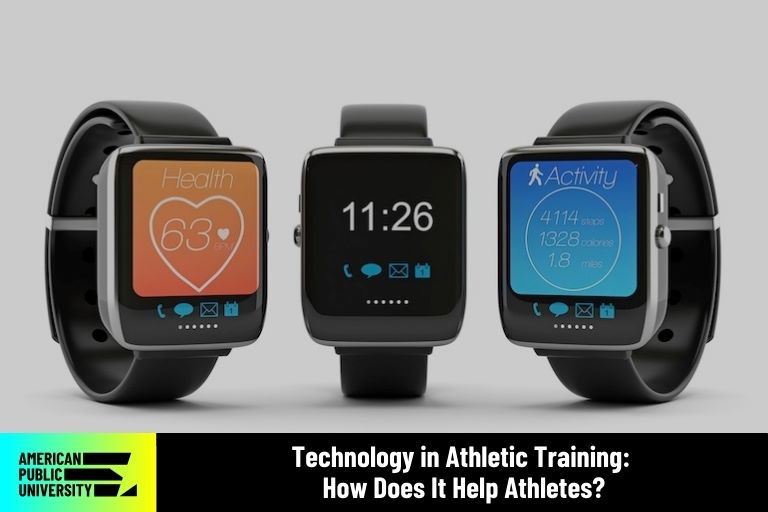
Wearable technology offers continuous, real-time data and analytics of athletic performance. Coaches, athletic trainers, and athletes can use various mobile devices, such as:
- Fitness trackers
- Smart watches
- GPS tracking devices (such as GPS vests) made from smart fabrics with built-in sensors
These tracking tools designed to be worn on the athlete's body collect metrics like speed, distance, heart rate, and recovery rate. They can even offer advanced analytics on the wearer’s stress and anxiety levels.
Wearable devices are allowing athletes to assess and improve their performance. Athletic trainers also use these devices to spot initial signs of fatigue or potential injuries to enhance their athletes' injury prevention.
Data Analysis and Sports Training with Real-Time Data
In addition to tracking real-time performance, the sports industry uses data analytics to find ways to improve the performance of individuals and sports teams. Coaches and athletic trainers have access to various tools for analyzing and visualizing vast amounts of data to aid team sports training sessions.
This visualization makes it possible to identify patterns and trends in an athlete’s performance. In this way, data analytics allows for a greater understanding of an athlete’s movement effectiveness, split times, and other factors.
Analytics moves coaching beyond assumptions into data-driven reasoning. With the data collected by GPS vests and other mobile devices, coaches can confidently tailor their training methods for each athlete and more closely analyze individual player performance.
Additionally, teams use data analytics to assess the effectiveness of their tactics, allowing for in-game adjustments and counterstrategies. Also, predictive analytics can reduce injury risk and help individuals to avoid plateaus when amateur or professional athletes train for competition.
Virtual Reality and Augmented Reality
Virtual reality (VR) and augmented reality (AR) are beneficial for helping to improve athletic techniques and provide recovery through helping athletes to develop greater awareness of their athletic performance. In virtual reality training, today's athletes can:
- Refine specific techniques
- Develop and rehearse mental strategies
- Participate in scenarios without the fatigue of competing
VR training is particularly useful in sports that require mental fortitude, such as football, basketball, or soccer.
AR provides athletes with prompts such as interactive texts during drills and workouts to enhance performance during drills and workouts. These real-time cues can aid with form corrections.
VR and AR also support rehabilitation by helping injured athletes regain their strength, balance, and coordination in real time. These technologies enable athletes to focus on proper movements and pacing throughout rehabilitation.
Injury Prevention and Recovery
Tracking devices such as motion sensors, capture systems, and pressure sensors have made detailed biomechanical assessments possible. These sensors help in detecting possible injuries, so that the body’s healing response has more time to work. Wearable technology that monitors workload and stress can also provide early warning signs of potential injury risk.
Cryotherapy chambers, electrical stimulation machines, and monitoring applications also support athletes recovering from injuries. They help athletes to manage pain, inflammation, and recovery to minimize their downtime from a particular sport.
Athletic Performance Enhancement
Performance enhancement tools range from mobile applications offering instant feedback on technique to smart gym equipment that automatically adjusts weight resistance. In addition, video analysis software can pinpoint problem areas regarding particular movement patterns.
Sports technology can foster an integrated training approach, balancing the physical, nutritional, and psychological aspects of improving performance. For example, athletes can use mobile apps to monitor their nutrition, hydration, and sleep. Biofeedback training systems help athletes enhance focus and mental fortitude by controlling their physiological responses to competition.
The Challenges of New Technology
The impact of technology on athletic training is evident. Nonetheless, significant hurdles remain.
The primary hurdle is cost. Unfortunately, advanced technology is out of reach for many sports organizations and amateur athletes. There is also the problem of disparity in technology use within both elite and grassroots programs.
The collection and distribution of sensitive health and performance information make biometric data privacy and security a concern. Furthermore, there are considerations about how and when to use an athlete’s personal information.
Over-reliance on data may also lead some coaches, trainers, and athletes to disregard foundational training principles for the human body. Ideally, people in the sports industry need to achieve a balance between high-tech methods and traditional coaching to achieve sustainable improvement.
The Outlook for Sports Technology
Sports technology has had a significant impact on how athletes prepare, compete, and recover. It is no longer a fad but is now the new standard.
Tracking to perfection in a bid to finish at the top is now possible for every motivated athlete on many teams. These technologies will drive the effectiveness of athletes as well as sports teams and prevent overtraining.
Artificial intelligence (AI) in sports training is becoming common. AI can filter hundreds of terabytes of data to support better decision-making. For example, AI-driven insights can determine weakness and rest recovery for individuals and configure the best training lineup.
The way athletes train is likely to become even more sophisticated with the introduction of AI, machine learning, and biotechnology. AI coaching will tailor training schedules to suit individual athletes’ needs, while machine learning will predict performance trends and injury risks with higher accuracy. Smart fabrics and nanotechnology may also be used to create clothing that self-adjusts to athletes’ needs in real time, even in extremely cold temperatures.
The Internet of Things (IoT) may enable devices and platforms to become more interconnected, forming ecosystems for training, recovery, and competition. Virtual reality is set to replace more basic forms of simulation, while augmented reality will enhance practice using real-time data. As these innovations become more commonplace, it may level the playing field in training methods between amateur and elite athletes.
New imaging technologies using optical character recognition cameras, monitoring devices, and motion capture outfits, can support personalized rehabilitation devices. This optimization, centered on biomechanical issues, speeds the recuperation process.
Innovation within sports technology will keep testing the limits of athletic performance. Athletes and trainers need to keep pace and accept new ways of working while retaining their personal tenets. If technology is developed in an ethical way, technological tools can offer greater inclusion and value across the world of sports.
The Master of Science in Athletic Development Management at APU
For adult learners interested in the science of training athletes and other related topics, American Public University (APU) has an online Master of Science in Athletic Development Management. In this academic program, students can take courses in motor learning, advanced biomechanics, and nutrition for sports performance. Other topics include advanced exercise and sport physiology, optimal sports performance, and techniques in coaching strategy.
To learn more details about this M.S. in athletic development management, visit APU’s nursing and health sciences degree program page.
Fitbit is a registered trademark of Google, LLC.
Dr. Matthew Loux is a criminal justice faculty member for the School of Security and Global Studies at American Public University. He holds a bachelor’s degree in criminal justice and a master’s degree in criminal justice administration from the University of Central Missouri State, a doctoral degree in management from Colorado Technical University, and a Ph.D. in educational leadership and administration from Aspen University.
Dr. Loux has been in law enforcement for more than 30 years. He has a background in fraud and criminal investigation, as well as hospital, school, and network security. Dr. Loux has researched and studied law enforcement and security best practices for the past 10 years.
Bryce Loux is an alumnus of American Public University. He holds a bachelor’s degree in fire science with a minor in criminal justice. Bryce is currently a student success coach.