By Dr. Matthew Loux and Bryce Loux | 01/27/2026
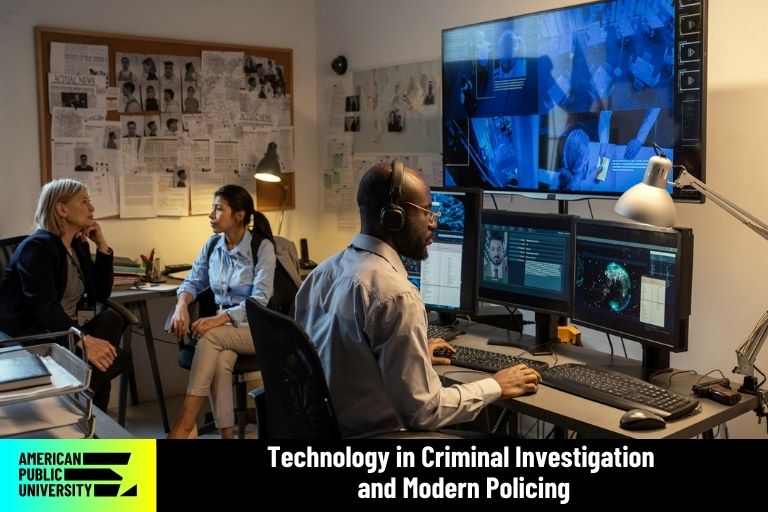
Rapid advancements in technology have dramatically improved how criminal investigations are conducted. Criminal cases have evolved from using conventional methods based on eyewitness accounts, confessions, and physical evidence to more accurate, efficient methods that employ sophisticated technology.
Technology has also transformed how crimes are examined. In addition, technological tools have helped law enforcement agencies collect evidence and identify patterns faster than ever in the criminal justice system.
Overall, the integration of technology into criminal investigations has made the whole criminal justice process more efficient, accurate, and reliable. The analytical capability of technology is beneficial in all aspects of a criminal investigation, ranging from DNA and cyber forensics to artificial intelligence and surveillance systems.
These advancements assist criminal justice professionals in strengthening public safety and supporting investigations with oversight mechanisms, including human oversight.
Laboratory Technology
Laboratory technology, a partner to forensic science, is the foundation of modern criminal investigations. Forensic science involves the scientific study of physical evidence to reconstruct events and to connect suspects, victims, and crime scenes.
It includes areas such as:
- DNA analysis
- Fingerprint analysis
- Biometric systems
- Ballistic and toolmark analysis systems
- Trace evidence analysis
DNA Analysis
DNA profiling is a significant advancement in the criminal justice field. Genetic profiles can now be created and analyzed from biological materials, such as:
- Blood
- Saliva
- Hair
- Skin
- Bone
- Teeth
- Other organic tissues
DNA analysis can be used to identify a perpetrator, confirm involvement, or clear a suspect. DNA evidence is crucial in any crime investigation and plays a major role in preventing or correcting wrongful convictions.
Thanks to this technology, analysts can connect multiple records across several databases. They can review cold cases and leverage large databases that preserve historical data and other valuable data critical to long-term investigations.
Fingerprint Analysis
For fingerprint analysis, the Automated Fingerprint Identification System (AFIS) is an electronic system that quickly compares fingerprints to millions of records. It can save investigators time in processing the fingerprints found at crime scenes. Also, fingerprints can be digitally enhanced to better determine their patterns, further expediting the process and enhancing the accuracy of results.
Biometric Systems
Biometric recognition technologies have decreased the time investigators devote to identifying, locating, and verifying crime suspects. In practice, these systems may include several software embedded in artificial intelligence systems, but they also raise accuracy, bias, and privacy issues tied to civil liberties and ethical considerations. Some of these technologies include:
- Facial recognition software
- Iris recognition software
- Voice identification
- Palm print analysis
Ballistic and Toolmark Analysis Systems
Advanced systems can quickly conduct comparisons of ballistic evidence (such as fired bullets and shells) to streamline the process of linking a crime to a specific firearm. Similarly, toolmark analysis of the destructive tools used in burglaries or assaults can be used to solve crimes faster.
Trace Evidence Analysis
Investigators use specialized tools, such as microscopes, chemical analyzers, and lab equipment to examine fibers, soil, paint, and residues from various other substances. This type of evidence can prove a connection between a suspect and a crime.
Digital Forensics
The increasing reliance of society on digital products and systems means that crime investigation can no longer ignore the increasing importance and complexity of evidence in digital systems. Investigators must collect and preserve digital evidence for modern technology investigations.
AI tools are also a useful addition to criminal justice technology. Data analysis with AI tools have allowed investigators to sort through a large amount of digital evidence to extract actionable intelligence.
Computer and Mobile Device Forensics
During an investigation, forensic teams look for evidence of digital data in computers, mobile phones, tablets, and external hard drives. Using special technology tools, including AI tools, forensics can restore files that were deleted, see communication records, and monitor what actions users have taken.
Handling digital evidence in the proper manner during criminal investigations is important to ensure digital evidence is valid in court and prevent data breaches. This evidence includes:
- Text messages
- Emails
- Call and message logs
- Photos
- Videos
- Data from various apps
Digital evidence can be used against a defendant, in accordance with due process. However, it is also important to protect sensitive information from tampering or exposure, including data breaches.
Internet and Network Forensics
Internet-based crimes such as fraud, identity theft, hacking, and cyberbullying demand the need for network forensic investigation. To trace criminal activities, investigators look at:
- IP addresses
- Server logs
- Internet traffic
- Online accounts
- Online transactions
Some cyber investigations usually need to be supervised by international authorities and homeland security personnel.
Surveillance Technology in Criminal Investigations
Surveillance technology is most important for collecting evidence collection, monitoring individuals, and putting together a timeline or “picture” of a crime. When used carefully, surveillance can help identifying suspects and clarifying disputed events. At the same time, care should be given to respect civil rights advocates and constitutional law.
This surveillance technology can include:
- Closed-circuit television (CCTV)
- Body-worn and vehicle cameras
- Drones
- Global positioning satellites (GPS) tracking
- License plate readers and vehicle recognition systems
CCTV
Closed-circuit television units in public places, businesses, and even homes are very helpful at recording evidence to help investigators understand what crimes have taken place. The videos can show who a suspect is and if that suspect moved into a certain area. Also, CCTV videos can verify what witnesses say in court.
Body-Worn and Vehicle Cameras
To capture crime scene interactions and collect evidence, police officers typically use body-worn cameras. Similarly, patrol vehicles come fitted with dash cameras to record traffic stops, pursuits, and evasion maneuvers.
Drones
Drones give investigators a way to analyze scenes from an overhead view. They are useful in:
- Capturing crime scene footage
- Monitoring suspect movements
- Aiding search and rescue efforts
GPS Tracking
Modern investigators can use global positioning satellite darts to track the location of a suspect. However, these devices for location tracking must be used carefully in order to avoid violating a suspect’s Fourth Amendment rights.
License Plate Readers and Vehicle Recognition Systems
In some jurisdictions, agencies rely on automatic license plate readers and vehicle recognition systems to document vehicle movements. These tools can improve leads in time-sensitive cases, but they require clear policies, retention limits, and clear regulations to prevent overreach.
Data Analytics and Criminal Intelligence
Modern investigations often rely on data analysis and intelligence-led policing. Some techniques include predictive policing models and machine learning to examine crime rates and patterns.
Crime Databases and Information Systems
Investigators can tap into centralized databases that house criminal histories, evidence records, and investigative reports. Improved data linking across multiple jurisdictions and access to databases enhance collaboration and case management. Law enforcement officers can more easily detect repeat offenders and conduct crime pattern analyses.
Criminal Intelligence Analysis
Criminal intelligence involves a more analytical approach to data to discover and analyze networks, structures, trends, and relationships. Criminal organization mapping, communication tracking, and visualization of suspect connections are examples of tools that analysts use.
This approach is particularly successful against networks involving terrorism, trafficking, and organized crime. Criminal intelligence is also valuable when the scale of criminal activity may require coordination from a diverse group of local or homeland security investigators, analysts, prosecutors, and community stakeholders.
Artificial Intelligence and Machine Learning
For law enforcement, emerging technologies such as artificial intelligence (AI) systems and machine learning (ML) has enhanced predictive analysis in the U.S. justice system by providing the means to analyze large datasets quickly and accurately. AI technology helps investigators improve efficiency and save time, but only when it is guided by human oversight to reduce human biases.
Facial Recognition Technology
AI systems can match surveillance footage to photo databases to assist investigators in identifying suspects and searching for missing persons.
Although effective, this technology and its processes raise concerns on accuracy and privacy, so it must be used in accordance with proper regulations and responsible usage. Without safeguards, communities may experience bias and discriminatory practices.
Predictive Policing Through Data Analysis
Investigators use machine learning algorithms to find patterns in crime data and predict future crimes in different areas. Informed predictive analyses can be used to:
- Allocate resources to crime hotspots
- Prioritize certain suspects
- Streamline the direction of an investigation
Geographic Information Systems
Geographic information systems (GIS) help investigators to analyze crime data spatially. Crime mapping for hotspot analysis and linking incidents to patterns in geography is an effective crime control measure.
GIS technology is also useful for the location of suspects and for identifying escape routes and the environment. Spatial analysis is a vital component in the investigation of serial crimes.
Evidence Collection and Crime Scene Technology
Technological advancements in evidence collection and crime scene processing have revolutionized the accuracy and efficiency of crime scene investigations.
Advanced Imaging and Precise Documentation
Crime scene investigation has been revolutionized by the 3D (three dimensional) scanning, laser mapping techniques, and digital photography. These technological advancements allow for the precise documentation of crime scenes.
Technology and Interviewing Techniques
Technology such as audio and video recording and behavioral analysis software helps to improve interviews and interrogations. For example, audio and video records of interviews documents what was said and provides a way to dispute any claims of coercion or false statements. Recorded interviews are also a way of preventing a legal case from becoming mired in legal problems and ensures the validity of evidence.
Some tools, such as behavioral analysis software, evaluate the flow of an argument, the presence or absence of stress indicators, and a suspect’s behavioral patterns. Although such tools are not a replacement for investigator judgment and must be used with care, they can make a positive contribution to the overall result of an investigation.
Challenges of Using Technology in Investigations
Modern investigations face evolving crimes and tools. Consequently, law enforcement agencies must balance innovation with legality, ethics, and professional judgment.
There are several challenges involved with the use of technology in criminal investigation. These challenges include:
- Privacy and civil liberties
- Data security and integrity
- Technology dependence
- Legal and ethical implications
Privacy and Civil Liberties
The use of surveillance, data collection, and other evidence collection methods should be balanced with personal privacy and the possible abuse of technology. Technology should be used in compliance with the law and in consideration of constitutional rights.
Data Security and Integrity
Digital evidence should always be kept from abuse, loss, or unwanted access. Evidence is only viable in court when its integrity has been maintained.
Technology Dependence
Some technology can contribute to the decline of a skill set when there’s an overreliance on that technology. Interpersonal communication, intuition, and critical thinking skills are all elements of an investigation that should not be replaced by technology tools. Technology should be used to support a decision, not make the decision.
Legal and Ethical Implications of Digital Evidence
Technology used in criminal cases is subject to legal and ethical considerations. Digital searches, electronic monitoring, and data collection must be properly authorized by investigators.
Courts are now paying more attention to how electronic evidence is obtained. When investigations are done legally and ethically, that enhances public trust from the general public. Documented policies, review processes, and proportionality standards are a necessity.
Professional Development in the Criminal Justice Field
Technological advancements in the criminal justice field require proper training. Investigators working for criminal justice agencies need to be trained not only on different types of technology, but also evidence legality and legal boundaries.
Continuous professional development is essential to ensuring competence. The use of technology will be more effective if there is cooperation between:
- Law enforcement
- Forensic practitioners
- Information technology (IT) specialists
This training can be supported through agency academies and relevant degree program coursework. It may also extend to different staff roles in different agencies as well as other relative environments in the criminal justice system, such as correctional facilities.
The Future of Technology in the Criminal Justice System
Criminal justice technology involves many areas, including artificial intelligence, instantaneous data processing, and sophisticated methods of data gathering and analysis. There are countless innovations to improve criminalistics, such as quantum computing, better biometric technology, and forecasting analytics. As emerging technology expands, agencies will face decisions about governance, validation, and resource allocation.
Inevitably, the debate on technology will include accountability, ethics, and the use of technology in crime. Investigations in the future will find a way to utilize technology while strengthening the principles of justice, privacy, and other basic human rights.
The Bachelor of Science in Criminal Justice at APU
For adult learners who are interested in understanding how to use technology to aid criminal investigations, American Public University (APU) has an online Bachelor of Science in Criminal Justice. This degree provides courses in a range of topics, including criminology, crime analysis, and criminal profiling. Other courses include ethics in criminal justice, criminal justice administration, and criminal law.
This degree offers a digital forensics concentration. Courses offered for this concentration include cybercrime, the criminal legal process, computer forensics, and different areas of digital forensics.
For more details about this bachelor’s degree in criminal justice, visit APU’s security and global studies degree program page.
Note: This degree program is not designed to meet the educational requirements for professional licensure or certification in any country, state, province or other jurisdiction. This program has not been approved by any state professional licensing body and does not lead to any state-issued professional licensure.
Dr. Matthew Loux is a criminal justice faculty member for the School of Security and Global Studies at American Public University. He holds a bachelor’s degree in criminal justice and a master’s degree in criminal justice administration from the University of Central Missouri State, a doctoral degree in management from Colorado Technical University, and a Ph.D. in educational leadership and administration from Aspen University.
Dr. Loux has been in law enforcement for more than 30 years. He has a background in fraud and criminal investigation, as well as hospital, school, and network security. Dr. Loux has researched and studied law enforcement and security best practices for the past 10 years.
Bryce Loux is an alumnus of American Public University. He holds a bachelor’s degree in fire science with a minor in criminal justice. Bryce is currently a student success coach.